

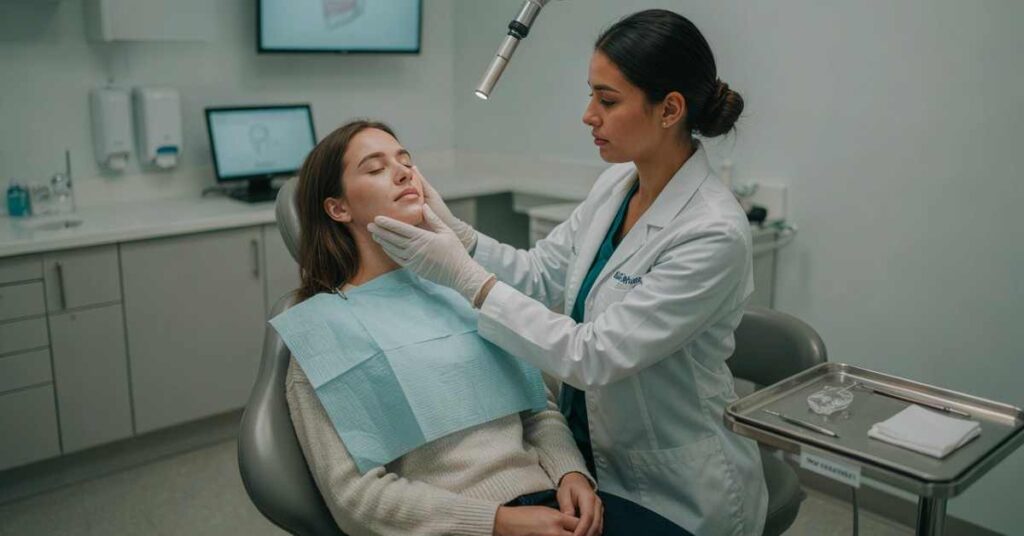
Your ear hurts. Your jaw clicks. You start wondering which one caused the other.
That’s a valid question, and the answer is surprising. TMJ challenges are rarely caused by an ear infection. The flip side is more common: jaw problems that seem to be an ear infection. Here’s how to differentiate them, and when to pay attention to each one.
Can an ear infection cause TMJ problems?
Rarely, yes. Doctors have reported rare cases in which a middle ear infection has spread to the jaw joint. Septic arthritis of the temporomandibular ligament joint is a rare result of a middle ear infection which can occur after severe otitis media or acute mastoiditis. The infection can spread through the bloodstream or straight through the thin bone dividing the ear in the joint socket. In children five and younger, that bone is not fully formed, which may make spread easier.
The numbers matter here. Acute otomastoiditis occurs in only about 0.2 to 2 percent of ear infections. So a typical earache in an adult is not going to turn into a jaw joint disorder.
The serious cases mostly involve small children. In one case series, six of seven patients went on to develop a stiff, fused jaw joint (ankylosis) within about three years, with trouble opening the mouth and changes in facial growth. That is why a child with a severe ear infection and new trouble opening the mouth should be evaluated promptly.
What about the everyday version, where a bad ear infection leaves you clenching or guarding your jaw for a week? That’s plausible, and we see jaw tension follow other kinds of pain. But it isn’t well documented as a cause of lasting TMJ disorder, so we won’t tell you it is.
When TMJ Feels Like an Ear Infection
The TMJ is located roughly half an inch in front of the ear canal. The trigeminal nerve serves both the joint and the ear, so an irritated joint can send pain signals that you feel in the ear. One ENT practice even notes that the joint is the most common source of adult ear pain.That is why so many people leave the ENT’s office with a healthy ear and no answers.
Some clues point to the jaw:
- The pain may become more noticeable when chewing, talking, or yawning.
- The jaw clicks, pops, or catches
- You wake with sore cheeks or a tight jaw
- There is no fever and no fluid from the ear
Signs That May Indicate a True Ear Infection:
- Fever, drainage from the ear, or sudden hearing loss
- A recent cold or sinus infection
- Pain that stays constant no matter how your jaw moves
We cover the symptom comparison in more detail in our post on why TMJ pain gets mistaken for an ear infection. If you’re unsure, start with a doctor, since an ear infection may need antibiotics.
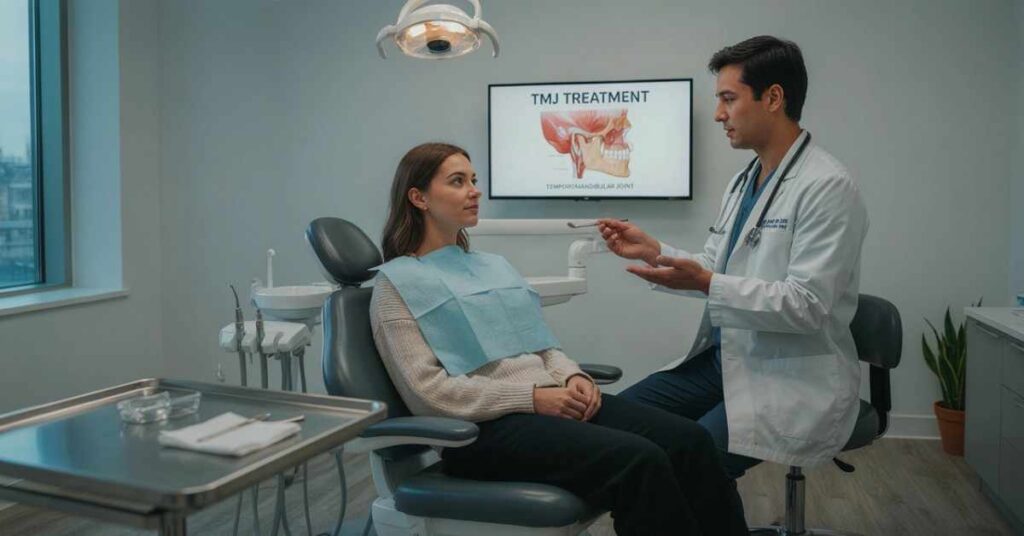
What actually causes TMJ disorders
Ear infections are only one part of the bigger picture. Common causes include stress clenching, arthritis, a bad bite, repetitive actions such as chewing gum heavily and injury to the jaw. Many persons with TMJ trouble also have a bite where the rear teeth don’t meet evenly, as well as clenching or grinding, especially at nite.This is where the dentist gets the appointment. You can see the pattern of crushing long before you notice it. Edges worn down. Molars flattened. Enamel broken.
Why age changes the picture
Older adults often carry several risk factors at once: arthritis, worn or missing teeth, and dentures or bridges that no longer fit the way they once did. Any of these issues can affect the way your jaw closes and moves. That’s why dental care for seniors in Roswell should consider the jaw joint as well as the teeth. If your dentures feel loose or your bite feels different than it did a year ago, tell us.
How we approach it at Roswell Complete Dentistry
We start by listening, then examining the joint, the muscles, your bite, and the wear on your teeth. If we suspect an active ear infection, we’ll send you to your physician first.
If the jaw is the likely source, treatment is usually conservative. A custom night guard can help shield your teeth from damage while you sleep. Stress habits, gum chewing, and sleep position sometimes need attention too. When the bite itself is part of the problem, our cosmetic and general dentistry services can help, through crowns, bonding, or Invisalign for alignment. Bite correction isn’t a guaranteed fix for jaw pain, and we’ll say so if we think it won’t help.
Routine teeth cleaning in Roswell, GA gives us a regular chance to spot grinding wear and jaw changes early. If you’re searching for a dentist near me in Roswell, GA because of jaw or ear pain that won’t settle, we can see you and sort out where it’s coming from.
Conclusion
TMJ issues do not often occur from an ear infection, and when they do it is typically only young children with really bad infections. More often compared to not, the jaw is the culprit and the ear is blamed. If your ear ache is matched by clicking, tightness or pain when chewing then a dental exam may save you weeks of guessing. If you also have a fever or discharge, see your doctor first.
Ready to understand what’s causing your pain? Contact Roswell Complete Dentistry and schedule a visit.
Frequently Asked Questions
1. Can an ear infection cause TMJ?
Rarely. Middle ear infections can spread to the jaw joint in uncommon cases, mostly in young children. Most TMJ problems have other causes.
2.Can TMJ cause ear pain?
Yes, often. The jaw joint is located close to the ear, so TMJ problems can often cause ear pain or a sensation of fullness.
3.How Can You Tell the Difference Between TMJ and an Ear Infection?
Fever, drainage, or sudden hearing loss point to infection. Pain that worsens with chewing or occurs alongside jaw clicking may indicate TMJ.
4.Should I see a dentist or a doctor first?
If you have fever or drainage, see a doctor. If your ear checks out fine, see a dentist.
5.Can TMJ go away on its own?
Mild cases sometimes settle with rest and lifestyle changes. Persistent pain should be examined.
6.Does treating TMJ help ear symptoms?
Often, when the jaw is the true source of the ear pain.
7.Do seniors get TMJ problems too?
Yes. Arthritis, tooth wear, and ill-fitting dentures can all affect the jaw.
About the Author
Dr. Pardis Koleini is a Georgia transplant who grew up in Boston. She earned her bachelor’s degree in biology and a Master of Medical Science from Boston University, then her DMD from Boston University’s Goldman School of Dental Medicine, graduating magna cum laude. She completed an Advanced Education in General Dentistry residency at Tufts University School of Dental Medicine. Dr. Koleini focuses on cosmetic and restorative dentistry, is Invisalign certified, and speaks Farsi. She practices at Roswell Complete Dentistry.
1875 Old Alabama Rd., Ste. 130
Roswell, GA 30076
Phone: 404-595-1840
Email: staff@roswellcompletedentistry.com


