

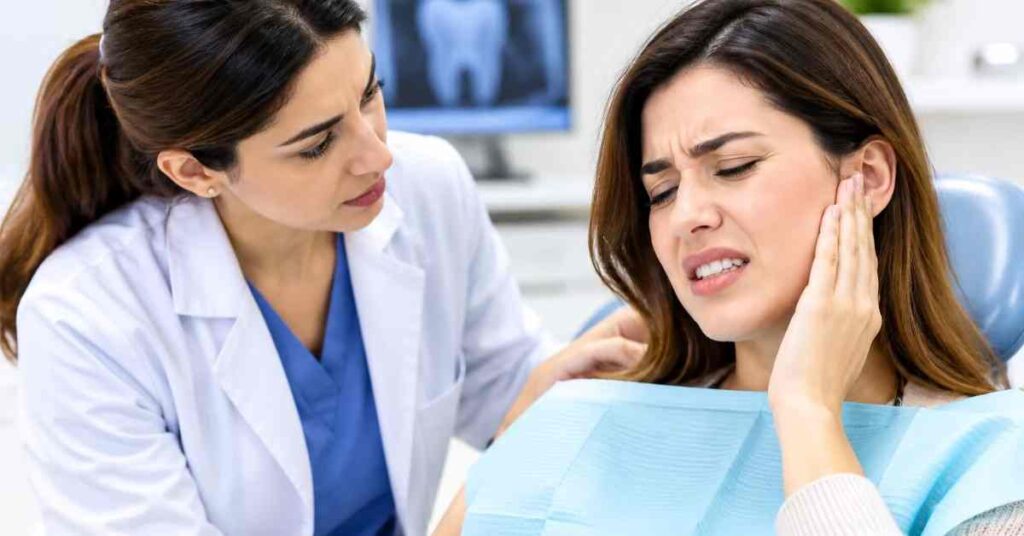
You bite into a sandwich, and a sharp ache shoots through your ear. You check your ear. It looks fine. No fever, no fluid, no blocked feeling. So what is going on?
Many people in this spot think they have an ear infection. But if the pain starts when you chew, yawn or talk, your jaw joint is a much more likely cause. Let’s look at why this happens and what you can do about it.
Why a Jaw Problem Feels Like an Ear Problem
Put your fingers just in front of your ears and open your mouth. You will feel a small joint move. That is your temporomandibular joint, or TMJ. You have one on each side, and they act like hinges that connect your lower jaw to your skull.
This joint sits right next to your ear canal. The nerves around it are also close to the nerves of the ear. So when the joint or the muscles around it get sore, your brain can mix up the signal and make you feel it in the ear. Doctors call this referred pain.
One small point: “TMJ” is the joint, and “TMD” (temporomandibular disorders) is the name for the problems. People often say “TMJ” for both. According to NIDCR, TMD is actually a group of more than 30 conditions that affect the jaw joint and chewing muscles.
Common Signs of a TMJ Problem
Ear pain alone does not prove TMJ trouble. Look for other clues too:
- Pain in front of the ear that gets worse when you chew, yawn or talk
- Aching in the cheeks, temples or neck
- A stiff jaw, especially in the morning
- Trouble opening your mouth wide
- Your jaw getting stuck or “locking”
- Clicking, popping or grinding with pain
- Headaches that start near the temples
Clicking by itself is not always a problem. NIDCR says jaw sounds without pain are common and don’t need treatment. It’s the pain that matters.
Why Does TMJ Pain Start?
Sometimes there is a clear reason, like an injury to the jaw. But NIDCR notes that for many people, the exact cause is not clear, and symptoms seem to start for no obvious reason. Things that may play a part include:
- Teeth grinding or clenching, often at night or during stressful days
- Stress, which makes people tighten their jaw without noticing
- Arthritis in the jaw joint
- Chewing very hard or chewy foods a lot
- Hormones. TMD is about twice as common in women as in men, mostly between ages 35 and 44
NIDCR also says about 5% of U.S. adults are affected, so if this is happening to you, you are not alone.
It Might Not Be TMJ
Ear pain when chewing can also come from other places. This is why a proper check matters.
- A tooth problem: A cracked tooth, a deep cavity or an abscess can send pain toward the ear. This pain often comes with heat or cold sensitivity, swelling or a bad taste.
- Gum trouble: Swollen, sore gums can ache when you chew. If gum disease is part of the picture, a dentist may talk about treatments such as gum disease laser treatment in Roswell, along with deep cleaning and better home care.
- An ear infection: This usually brings muffled hearing, fever or fluid.
- Sinus pressure: This often comes with a stuffy nose and pressure that is there even when you aren’t chewing.
A dentist can tell these apart by looking at your teeth, gums and jaw, and by asking when the pain began.
What You Can Try at Home
Many jaw problems settle down on their own. NIDCR says symptoms go away without treatment for many people, and that simple care is often enough. For a few days, you can try:
- Eat soft foods like soup, eggs, yogurt and pasta
- Put an ice pack on the sore side, or a warm cloth if the muscles feel tight
- Skip gum, hard candy and tough meats
- Keep yawns small and avoid opening very wide
- Relax your jaw. Teeth should be slightly apart and lips closed when you are resting
- Use an over-the-counter pain reliever as the label says
If the pain lasts more than a week, or keeps coming back, don’t just wait it out.
When It Becomes an Emergency
Some signs should not wait for a routine visit. Seek emergency dental care in Roswell if you notice:
- Your jaw is locked and won’t open or close
- Swelling in your face, jaw or neck
- Fever together with tooth or jaw pain
- Pain that is severe or getting worse fast
- Pain after a hit or injury to the face
- A tooth that is broken, loose or throbbing
If you have trouble breathing or swallowing, or the swelling is spreading quickly, go to the nearest ER right away.
For everything else, Roswell Complete Dentistry offers same-day help for emergencies. Call before noon on 404-595-1840, and the team will do their best to see you that day.
How a Dentist Can Help
At your visit, the dentist will ask about your pain, feel your jaw as you open and close, check your bite, and look at your teeth and gums. There is no single standard test for TMD, so a careful exam is important.
Treatment is usually gentle. It may include jaw exercises, a custom night guard if you grind your teeth, stress tips, or a plan to fix a tooth or gum issue that is adding to the pain. If you have worn or chipped teeth from years of grinding, Cosmetic and General Dentistry can repair them and protect your smile at the same time.
If cost worries you, ask about a dental membership plan in Roswell. These plans can make regular checkups easier to afford if you don’t have insurance.
Conclusion
Ear pain when chewing is confusing, but it is often a sign from your jaw, not your ear. TMJ problems are common, and many get better with rest and simple care. Still, the same pain can come from a tooth, your gums or an infection, so it is smart to have it checked if it lasts or gets worse. Don’t ignore it, and don’t wait until it is hard to eat or sleep. If you need emergency dental care in Roswell, call Roswell Complete Dentistry at 404-595-1840 or book online.
FAQs
1. Can TMJ really cause ear pain without an ear infection?
Yes. The jaw joint sits right next to the ear canal, so pain from the joint often feels like it is inside the ear.
2. Is a clicking jaw dangerous?
Not always. If there is no pain and no locking, clicking is common and usually needs no treatment.
3. Will TMJ pain go away on its own?
Often it does, especially with rest, soft foods and less stress. If it lasts more than a week or keeps returning, see a dentist.
4. Which doctor should I see first, a dentist or an ENT?
If you have no signs of ear infection, such as fever, fluid or hearing loss, start with a dentist. They can check your teeth, gums and jaw together.
5. Can stress cause jaw and ear pain?
Yes. Stress makes many people clench or grind their teeth without knowing it, which strains the jaw muscles.
6. Does Roswell Complete Dentistry see emergencies?
Yes. Call 404-595-1840 before noon for same-day care. Office hours are Monday to Thursday 8 AM to 5 PM, and Friday 8 AM to 2 PM.
About the Author
Dr. Pardis Koleini is a dentist at Roswell Complete Dentistry. She earned her DMD from Boston University’s Henry M. Goldman School of Dental Medicine, graduating Magna Cum Laude, and completed her residency at Tufts University School of Dental Medicine. She focuses on cosmetic and restorative dentistry, is Invisalign certified, and speaks Farsi. Patients know her for listening first and then building a clear, personal treatment plan.
1875 Old Alabama Rd., Ste. 130
Roswell, GA 30076
Phone: 404-595-1840
Email: staff@roswellcompletedentistry.com


