

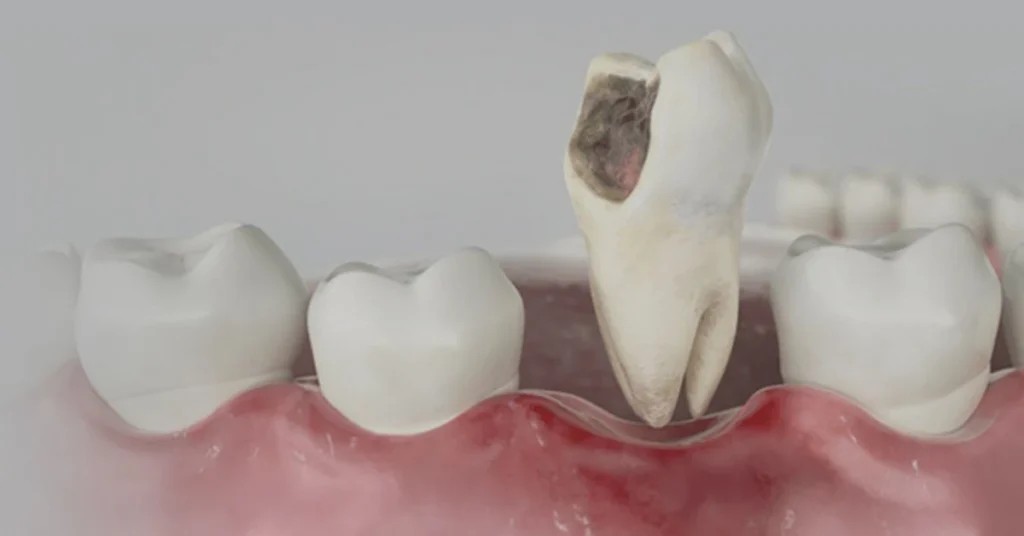
Bleeding gums when you brush get written off a lot. Brushed too hard, people figure, or it’s nothing. Sometimes that’s true. But bleeding gums are also one of the first signs of gum disease, and it’s a condition that gets a lot more manageable the earlier you catch it. At Roswell Complete Dentistry, we see patients across every stage of gum disease, from mild irritation to cases that have been ignored for years, and the treatment path looks pretty different depending on where you land.
Here’s what gum disease actually is, what treating it involves, and why waiting on it usually costs you more than showing up sooner would.
What gum disease actually is
Gum disease starts as gingivitis, an infection caused by plaque buildup along the gumline. Your gums might look a little red, feel puffy, or bleed when you floss. At this stage it’s reversible with a good cleaning and better home care.
If it’s left alone, though, it can turn into periodontitis. That’s when the infection works its way below the gumline and starts breaking down the tissue and bone that actually hold your teeth in place. Pockets open up between the teeth and gums, bacteria settle into them, and the damage builds from there. Left untreated long enough, it leads to loose teeth, receding gums, and eventually tooth loss. It’s also been linked to heart disease and complications with diabetes, so it’s not just a mouth problem.
Signs worth paying attention to
A few things tend to show up before people take gum disease seriously:
- Gums that bleed when you brush or floss
- Gums that look red, swollen, or tender
- Breath that doesn’t go away with mouthwash
- Gums pulling back from your teeth
- Teeth that feel a little loose
- Pain when chewing
Any one of these on its own isn’t necessarily alarming. A few of them together, especially bleeding plus bad breath plus tenderness, usually means it’s time for an exam.
How gum disease gets treated
Treatment depends entirely on how far things have progressed, which is why the first step is always an exam and a set of pocket depth measurements around each tooth. That tells us exactly what we’re dealing with.
For gingivitis, a professional cleaning is often enough on its own. We remove the plaque and tartar buildup causing the irritation, walk you through better brushing and flossing habits, and in most cases the gums heal up within a couple of weeks.
Once it’s progressed to periodontitis, scaling and root planing is usually the next step. It’s a deeper cleaning than a routine checkup, one that goes below the gumline to clear out plaque and tartar from the tooth roots and smooth the root surface so gums can reattach more easily. It’s done in sections, sometimes over two visits, with a local anesthetic so it isn’t uncomfortable. For patients with a stubborn infection, we’ll sometimes pair this with an antibiotic, either applied directly into the gum pockets or taken orally, to help get the bacteria under control.
For more advanced cases, where pockets are deep or bone loss has already happened, surgical options come into play, things like flap surgery or bone and tissue grafts. These aren’t the first move for most patients. They’re what happens when non-surgical treatment hasn’t been enough to stop the disease from progressing.
Whatever stage you’re at, gum disease treatment doesn’t end after one visit. Periodontal maintenance, typically cleanings every three to four months instead of the standard twice a year, is what keeps the disease from creeping back once it’s been treated.
If you’re looking into gum disease laser treatment Roswell patients recommend, it helps to know upfront that most cases don’t need surgery at all. Scaling and root planing paired with consistent maintenance handles the majority of what we see.
What a visit actually looks like
Your first appointment starts with a full periodontal exam. We measure pocket depth at multiple points around every tooth, take X-rays to check for bone loss, and go over your health history, since things like smoking and diabetes affect how gum disease behaves and how it responds to treatment. From there, we’ll walk you through exactly what stage you’re at and what treatment makes sense.
Most non-surgical treatment is done under local anesthetic, so there’s minimal discomfort during the appointment itself. Afterward, your gums might feel a little tender for a day or two, similar to how they feel after a deep cleaning. Patients looking for gum disease treatment Roswell offices provide often ask how many visits it takes. For scaling and root planing, it’s usually one or two, plus a follow-up a few weeks later to check healing and pocket depth again.
What you can do at home
Treatment gets you back to a healthy baseline, but keeping it that way is mostly on daily habits. Brush twice a day, actually get down along the gumline and not just the tooth surface. Floss daily, since that’s the part a toothbrush can’t reach. An antibacterial mouthwash can help in between cleanings. And if you smoke, quitting is one of the single biggest things you can do for your gum health, since smoking slows healing and makes gum disease harder to treat.
Why choose Roswell Complete Dentistry
Patients researching gum disease treatment Roswell has to offer usually want the same thing: a straightforward plan, explained clearly, without being pushed toward more than they actually need. That’s how we approach it. We start with the least invasive option that will actually work and go from there.
Frequently asked questions
1. Does gum disease go away on its own?
Gingivitis can improve with better home care, but it doesn’t fully resolve without a professional cleaning to remove the plaque and tartar causing it. Periodontitis won’t reverse on its own at all.
2. Is scaling and root planing painful?
It’s done with local anesthetic, so most patients don’t feel much during the procedure. Some tenderness for a day or two afterward is normal.
3. How do I know if I have gum disease?
Bleeding gums, persistent bad breath, and gum recession are the main signs. The only way to know for sure is a periodontal exam with pocket depth measurements.
4. Can gum disease come back after treatment?
Yes, if home care and regular maintenance cleanings fall off. That’s why periodontal maintenance visits every three to four months matter so much after treatment.
5. Is gum disease linked to other health problems?
Research has connected it to heart disease and complications with diabetes, among other conditions, which is part of why treating it early matters beyond just your teeth.
Conclusion
Gum disease is common, but it’s not something that fixes itself, and the longer it’s ignored, the more treatment it usually takes to get things back on track. Catching it at the gingivitis stage means a simple cleaning is often all you need. Catching it later still gives you options, just more involved ones. Either way, the earliest visit is always the easiest one. If it’s been a while since your last checkup or you’ve noticed any of the warning signs above, that’s reason enough to get seen.
Author Bio
Dr. Pardis Koleini is a Boston University trained dentist specializing in cosmetic and restorative dentistry, Invisalign certified, and fluent in Farsi. She believes great dentistry starts with listening, crafting personalized care plans for every patient at Roswell Complete Dentistry.
1875 Old Alabama Rd., Ste. 130
Roswell, GA 30076
Phone: 404-595-1840
Email: staff@roswellcompletedentistry.com


